
Why “Precision” Isn’t Enough for the FDA: A Lesson in Method Equivalency.
I’ve been diving deep into a specific FDA 483 observation recently that every Analytical Lead and QA Manager should keep on their radar. It highlights a common trap: confusing Precision with Equivalency.
🔹 The FDA 483 Observation (As Issued):
“Your firm performed assays using both in-house method and the compendial method and calculated relative standard deviation (RSD) for each method’s data. Your firm then inappropriately combined results from both methods to calculate an overall RSD value. Calculating RSD values is a measure of precision, not a statistical test for method comparison. Your firm did not conduct any statistical testing to demonstrate that your in-house method performs equivalently…”
🔸 What is “Inappropriate” and Why?
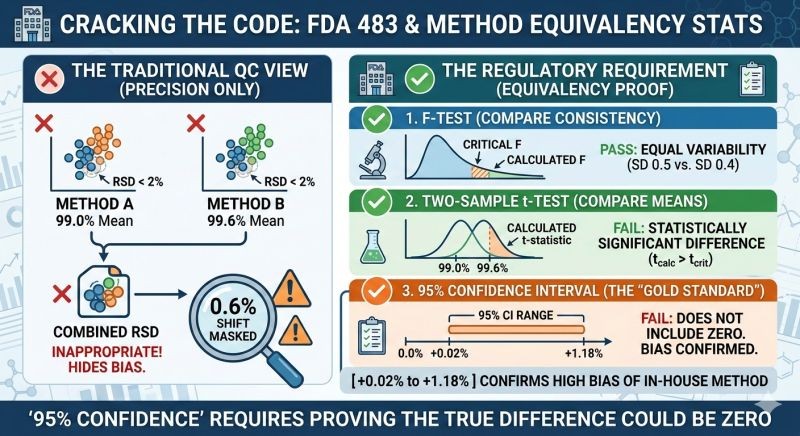
RSD is a measure of Precision (how close the shots are to each other). It is NOT a measure of Equivalency (whether you are hitting the same target).
The scenario:
Method A (USP): Mean 99.0%, SD 0.5
Method B (In-House): Mean 99.6%, SD 0.4
Difference: 0.6%
By combining the RSD, the firm masked that 0.6% shift. The FDA’s concern is Bias. If your In-House method consistently reads 0.6% higher, you risk passing a batch that should have failed (a “False Pass”).
🔹 The Solution: Hypothesis Testing
To prove equivalency, you must move beyond RSD and use:
F-test: To compare consistency (Variances).
t-Test: To compare the “Truth” (Means).
95% Confidence Interval (CI): The “Gold Standard” for proof.
🔸 The Acceptance Criteria (Simplified)
For a method to be truly equivalent, you need to pass the “Zero Rule” using the 95% Confidence Interval.
The Goal: Calculate the range of the difference between the two methods.
The Rule: That range MUST include Zero.
Example: If the range is -0.2% to +1.0% → PASS. (Zero is in the range; the difference is likely just random noise).
If the range is +0.02% to +1.18% → FAIL. (Zero is NOT in the range; your method has a statistically proven “High Bias”).
👉 The Takeaway
If that range doesn’t include zero, your methods aren’t the same—no matter how low your RSD is.
In our case, the lab was “too good”—their high precision (low SD) made the t-test so sensitive that it flagged a tiny 0.6% difference as a failure.
Leave a Reply